Energy
Sun, wind and battery

Technical concept · July 2026 · Preliminary phase
A self-sustaining energy complex for year-round living at Merigar East.
Original presentation concept · not a final design
01 / The foundation
We are not building a power plant; we are building a chain of life. An isolated site lives year round only if energy powers the water, the comfort and the people who care for it. Break one link and the place falls empty between seasons.
Excellent sun and observed winter wind could cover each other’s weak season. Solar is supported by resource data; wind must be validated by a survey mast.
Sun, wind and battery
Well pumping and irrigation
Trees, gardens, fruit and herbs
Warm, liveable homes all year
People present to tend the place
 43.9° N · coastal Dobruja
02 / The place
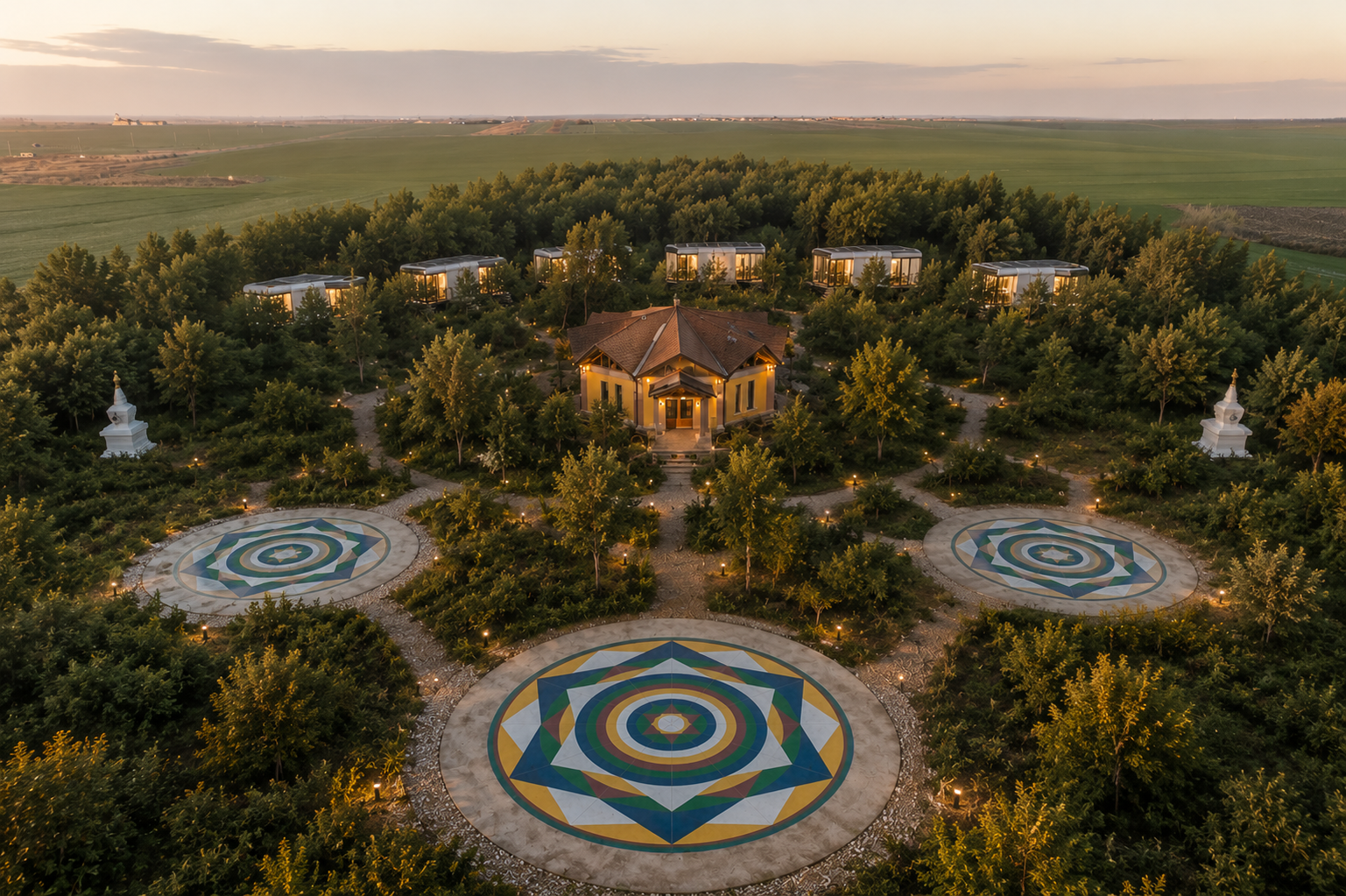
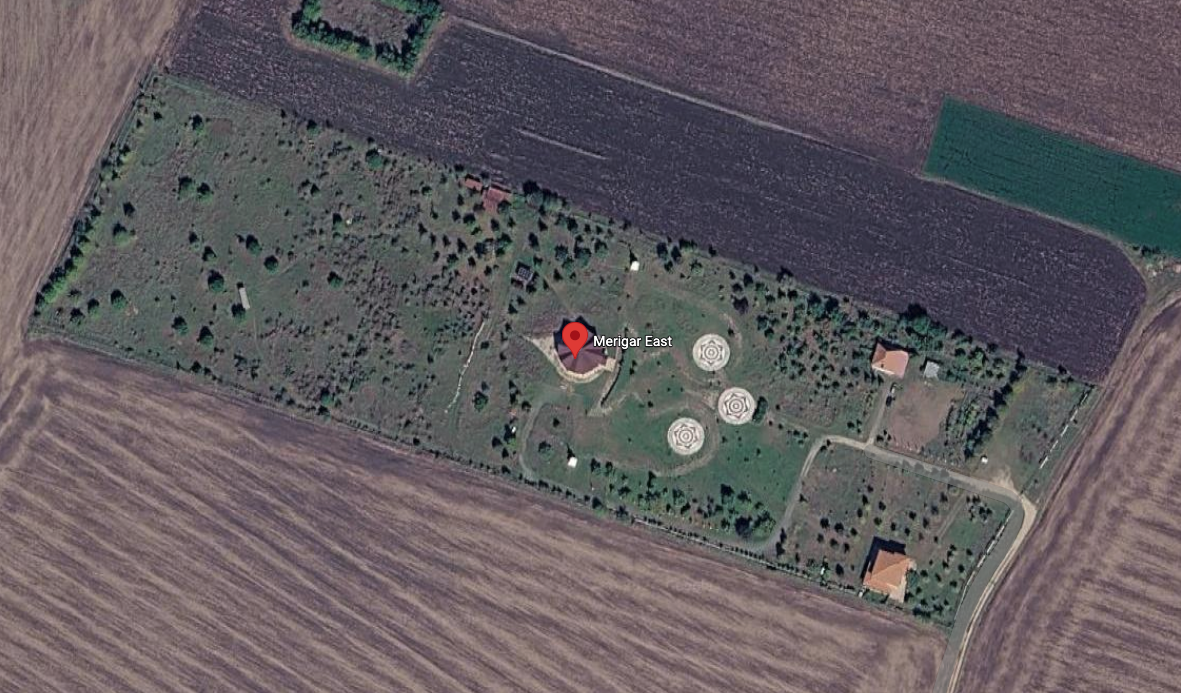
Near the village of 23 August in Constanța County, the roughly 3–4 hectare site already holds a gompa, a dormitory and a well. The proposal adds nine dwelling modules behind the gompa, beyond the camping site, a fruit and herb drying facility and an EV charger. The task is to size a hybrid system that covers the winter load of an isolated site under environmental constraints on wind installations.
Design constraint: the site lies within the Via Pontica migratory corridor and Natura 2000 context, so wind infrastructure must follow environmental consultation—not lead it.
03 / Demand
Prospective daily consumption for the site’s planned operating mode. These figures are model assumptions, not measured use.
| Season | Dwellings ×9 | Dormitory | Gompa | Pump · 3 kW | EV + common | Total |
|---|---|---|---|---|---|---|
| Winter | 61 | 14 | 16 | 1 | 23 | 115 kWh/day |
| Shoulder | 39 | 8 | 6 | 5 | 25 | 83 kWh/day |
| Summer | 25 | 6 | 1 | 12 | 28 | 72 kWh/day |
≈32.8 MWh annual base load. Heat pumps carry the base heating load, while wood covers peak cold and lowers the electrical winter peak.
Still to validate: coincidence analysis for peak kW, inverter and battery sizing; real heat pump profiles; and confirmed well parameters.
04 / Resources
Solar resource
The presentation identifies coastal Dobruja as one of Romania’s strongest solar regions for fixed-tilt, ground-mounted panels.
Design input: obtain PVGIS data for the exact coordinates at the design stage.
Wind observation
Estimated power density: ≈195 W/m² at Weibull k=2. The deck cites a good Global Wind Atlas resource at 50–100 m, above the constrained mast height.
Decision gate: a 12-month anemometric survey before any investment decision.
05 / Seasonal balance
The core idea is seasonal complementarity: coastal Dobruja’s strong solar resource peaks in summer, while observed wind appears strongest from November to March. The wind assumption still needs a full year of measurement.
Monthly balance · kWh
Generation bars combine 50 kWp of solar with a provisional 10 kW wind system. The white marker shows monthly load, not generation.
Solar supplies 76% of modeled annual generation; wind supplies 24%, concentrated in the solar winter minimum.
December check: 1,350 kWh solar + 2,988 kWh wind against 3,571 kWh load = 1.21× modeled coverage. A cloudy, windless multi-day spell still starts the generator.
06 / Configuration
Full capacity remains subject to “Phase 0” validation. Each element has a clear role and a fallback.
Solar
Ground-mounted in the southern meadow; vertical bifacial fencing remains an option for the winter profile.
Wind
A horizontal-axis turbine only after a 12-month survey and environmental approval. The concept remains viable without it.
Storage
LFP battery sized for roughly 1–1.5 days of winter autonomy, with final chemistry and C-rate to be validated.
Heat
Heat pumps carry the base demand; wood or pellets cover peak cold and reduce the electrical winter peak.
Backup
Emergency generator support, targeting less than 5% of annual energy rather than an unrealistic promise of total autonomy.
Networks
Low-voltage power and water distribution below frost depth to homes, common spaces and productive gardens.
The configuration lists approximately 710 m of network runs; the budget allows 850 m of trenches. These different quantities need reconciliation during detailed design. Annual generation is approximately 2.8 times the base load, allowing for off-grid operation, cloudy periods and production activity.
07 / Budget · July 2026
Indicative prices from the July 2026 bill of quantities. These are preliminary estimates, subject to design, surveys and permits.
08 / Constraints
Consult APM Constanța before committing to a horizontal-axis mast. A smaller vertical-axis system—or no wind—is the fallback.
Wind power scales with the cube of speed: 4.8 instead of 5.5 m/s cuts expected yield by about 35%. A 12-month anemometric survey is required before investment.
A 150 kWh battery cannot bridge every 3–5 day cloudy and windless winter spell. Backup remains part of resilience.
More solar, a larger battery, wood combined heat and power to be assessed, and more generator hours. The presentation anticipates covering winter demand at a higher cost.
09 / Engineering review
The energy model, drying-facility business plan and legal due-diligence checklist are available as working materials.
Start a technical conversationCoincidence analysis and peak kW for the inverter fleet and battery C-rate.
AC or DC coupling for 50 kWp solar, wind and 150 kWh storage, and the choice of energy management system (EMS).
Ground-source versus air-source heat pumps: real coefficient of performance (COP) under the site’s winter profile.
A bankable survey mast: measurement heights, sensors and standard.
Lightning protection and earthing for isolated metal modular dwellings.
A maintenance strategy that separates local service from contracted expertise.
A living mandala, shaped by many hands
Merigar East has grown through practice, volunteer work and shared care. This vision asks energy to serve that continuity: quietly, responsibly and for the long term.